

Who's Trying to Sink Your Boat?


In the late 2000s, a viral video illustrated typical results of employee engagement surveys across major corporations. In the video, the total workforce was depicted as 10 rowers in a rowboat (screen shot below). Of the 10 rowers, three were rowing as fast as they could, five were staring at the scenery and two were actively trying to sink the boat. The punchline: if 50% of your team is apathetic and 20% are active saboteurs, it does not bode well for overall performance and future success.
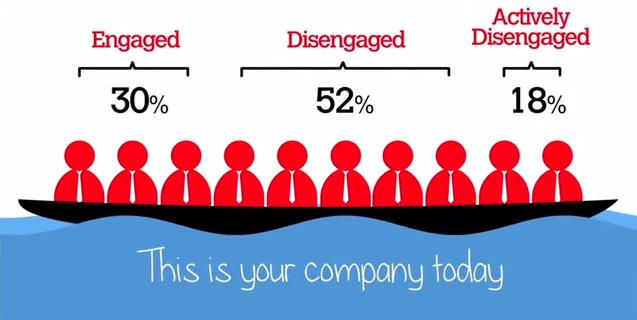
Two decades later, the employment landscape is different, but this workforce dynamic remains. After employers endured the Covid years of “Quiet Quitting” and the Great Resignation when employees held the upper hand, the power balance has shifted back in favor of employers, due to efficiency (or at least promised efficiency) brought about by AI.
With this shift, strategic talent questions abound:
Should we slow down hiring entry-level talent as AI seems poised to assume routine tasks?
Will once divergent but tangential roles now converge (e.g. Product and Tech) as AI models (e.g. Claude Code) commoditize technical expertise?
Will the role of the manager change? Will spans of control increase considerably as common tasks are augmented by AI or will every role become a manager insofar as they are expected to manage AI Agents?
Answers to these questions are unknowable, but one thing is certain: leaders will need their employees to be fully engaged and aligned to work through any scenarios. It’s odd to feel the need to say this, but we are still a human-centric society: businesses are run by and serve humans and still need human employees to decide what works across different functions, businesses and geographies. Employers need employees to operate in good faith - earnestly using new tools, adopting new ways of working, and accepting that at first it may feel inefficient and clunky at best, and job-threatening, at worst.
While redoubling efforts with employees during this time may seem unnecessary, it will almost certainly lead to better outcomes for the companies’ efforts to adopt AI-reliant initiatives. Engaged and valued employees are a bulwark against AI-related apathy or efforts to sabotage progress.
Over the next decade, I firmly believe that leaders and organizations who build cultures where both humans and AIs thrive will be the winners. To this end, in a time when many organizations may have over-indexed on AI, leaders should recognize and reward traits that comprise “human exceptionalism”: original thought, moral clarity, sound judgment, and clear communication. These traits may not easily map onto current talent review criteria, as leaders may have historically been chosen for institutional knowledge, technical expertise, or even AI-fluency. As such, organizations may need to re-examine talent criteria to select for people who exhibit these traits, develop them over the coming years and prepare them for larger, more strategic roles.
As technology changes at an increasingly rapid pace, so too must the speed with which leaders shape (and reshape) their workforce. Leaders should make these difficult decisions without the nagging worry that there are some in their ranks whose motives run counter to those of the organization – that is, deliberately trying to sink their boat. To set the right course, organizations first need to stabilize and secure their crew, with human-centric leadership at the helm.

